
L-Citrulline
Also known as: Citrulline, 2-Amino-5-(carbamoylamino)pentanoic acid
A non-proteinogenic amino acid recycled through the urea cycle that elevates plasma L-arginine levels, enhancing endothelial nitric oxide synthase (eNOS) substrate availability and systemic NO production.
Last reviewed: 2024-02-20 · 3 indexed studies
Set your location for accurate regulatory status
Saved on this device — no sign-in needed.
Overview
L-Citrulline is a non-essential amino acid that serves as the most effective oral precursor to nitric oxide (NO) production. It bypasses hepatic first-pass metabolism better than L-arginine, making it superior for raising plasma arginine and NO levels.
Mechanism & Function
L-Citrulline · C₆H₁₃N₃O₃ — source: PubChem CID 9750
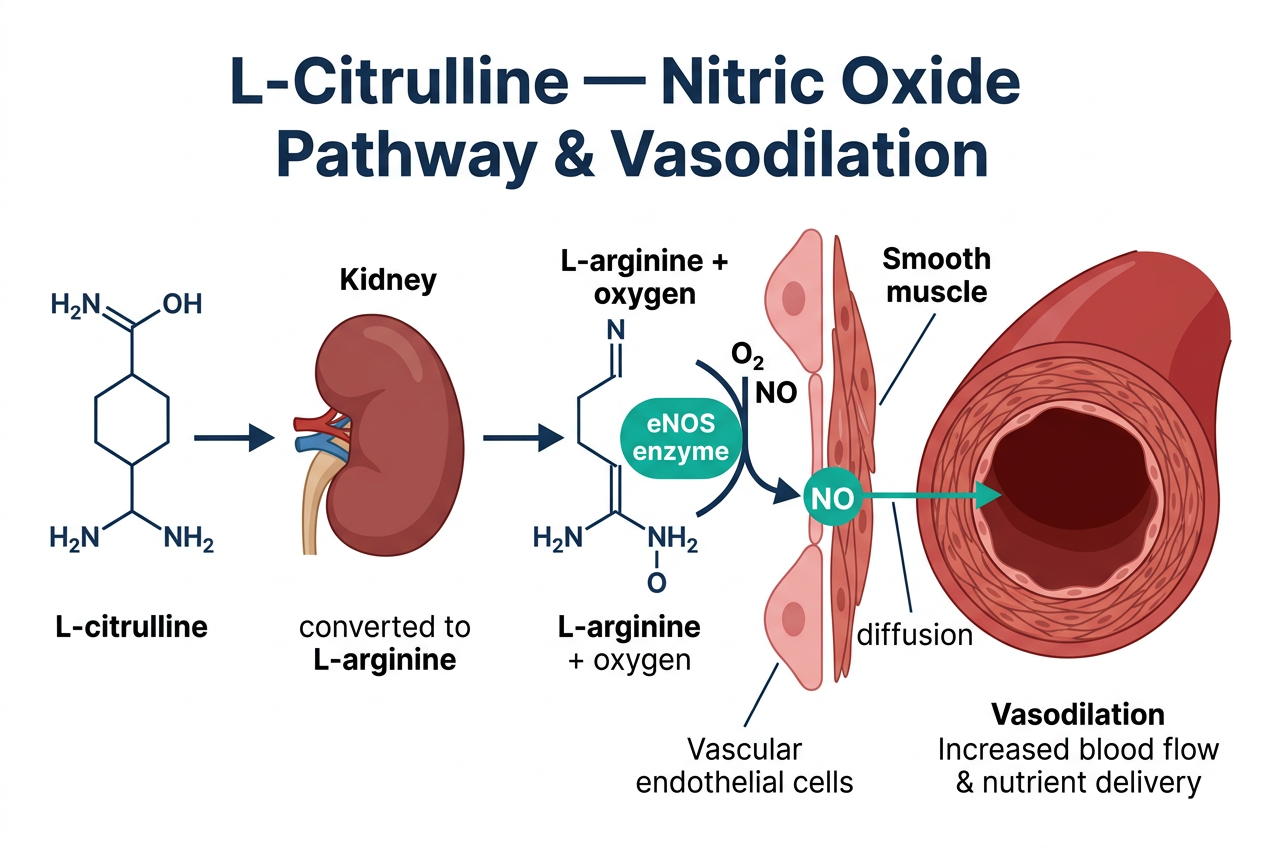
L-Citrulline is converted to L-arginine in the kidneys, then via eNOS to nitric oxide — driving vasodilation and increased blood flow.
White crystalline amino acid. Sour taste in solution; often blended with malate.
- Powder
- Capsule
- RTD
Powder is generally preferred for bioavailability or efficacy.
Mechanism of Action
Converted to L-arginine in the kidneys, bypassing hepatic arginase. Elevated arginine serves as substrate for eNOS, producing nitric oxide that relaxes vascular smooth muscle, increasing blood flow and nutrient delivery.
Physiological Role
Key intermediate in the urea cycle and arginine-citrulline recycling pathway. Oral citrulline raises plasma arginine more effectively than oral arginine itself due to bypassing hepatic first-pass metabolism.
Primary Pathways
Performance / Health Relevance
Enhances blood flow to working muscles, improves oxygen and nutrient delivery, reduces perceived exertion during high-rep resistance training, and may improve time-to-exhaustion.
Evidence Review
Practical Use & Dosage
- Minimum Effective Dose
- 3g L-citrulline or 6g citrulline malate (2:1)
- Optimal Range
- 6–8g L-citrulline or 8–10g citrulline malate pre-workout
- Upper / Caution Level
- 15g/day (well-tolerated)
- Timing
- 30–60 minutes pre-workout
- Best Format
- L-citrulline powder (not citrulline malate — pure citrulline provides more active compound per gram)
- Bioavailability
- ~80% oral bioavailability. Superior to L-arginine for raising plasma arginine (~30% bioavailability). Citrulline malate provides ~57% citrulline by weight.
- Absorption Considerations
- Well absorbed on empty stomach. Can be taken with or without food.
Safety & Interactions
Side Effects
- •Mild GI discomfort at very high doses
Contraindications
- Concurrent nitrate or PDE5 inhibitor use (additive vasodilation)
- Severe hypotension
Drug Interactions
- •PDE5 inhibitors (additive vasodilation)
- •Nitrates
- •Antihypertensives
Who Should Avoid
- •Those on nitrate medications without physician guidance
Monitoring
Monitor blood pressure if combining with antihypertensives. Generally very safe.
Frequently Asked Questions
Auto-generated from indexed evidence — dosage, safety, interactions, and more.
When is L-Citrulline typically used or indicated?
L-Citrulline is most commonly used for: Pre-workout vasodilation, Endurance performance, Blood pressure support, Muscle pump. Key intermediate in the urea cycle and arginine-citrulline recycling pathway. Oral citrulline raises plasma arginine more effectively than oral arginine itself due to bypassing hepatic first-pass metabolism.
How does L-Citrulline work?
Converted to L-arginine in the kidneys, bypassing hepatic arginase. Elevated arginine serves as substrate for eNOS, producing nitric oxide that relaxes vascular smooth muscle, increasing blood flow and nutrient delivery.
What is the recommended dose of L-Citrulline?
The optimal range is 6–8g L-citrulline or 8–10g citrulline malate pre-workout. with a minimum effective dose of 3g L-citrulline or 6g citrulline malate (2:1). Best taken: 30–60 minutes pre-workout. Upper / caution level: 15g/day (well-tolerated).
What are the side effects of L-Citrulline?
Reported side effects include: Mild GI discomfort at very high doses. Monitoring: Monitor blood pressure if combining with antihypertensives. Generally very safe.
Does L-Citrulline interact with medications?
Known or theoretical interactions: PDE5 inhibitors (additive vasodilation); Nitrates; and Antihypertensives. Always check with a clinician before combining with prescription medication.
Who should avoid L-Citrulline?
L-Citrulline is generally not recommended for: Those on nitrate medications without physician guidance; Concurrent nitrate or PDE5 inhibitor use (additive vasodilation); and Severe hypotension.
How strong is the evidence for L-Citrulline?
Evidence level: Moderate (overall score 74/100), based on 3 indexed studies on SuppIndex.
Research & References (3)
L-citrulline supplementation and exercise performance: a systematic review
Review of 12 studies showing L-citrulline reduces perceived exertion, increases repetitions to failure, and may improve time-to-exhaustion.
Oral L-citrulline supplementation enhances cycling time-trial performance in healthy trained men
Acute crossover RCT of L-citrulline on 4-km cycling time trial.
Effect of L-citrulline on plasma arginine and nitric oxide bioavailability: dose-response RCT
Dose-response trial comparing L-citrulline and L-arginine for raising plasma arginine and NO metabolites.
Trademark Ingredients

Related Ingredients
Other top-rated ingredients in Pump and Performance Ingredients.
Nitrosigine®
82/100Inositol-stabilized arginine silicate complex that provides sustained elevation of plasma arginine (up to 6 hours) and silicon, enhancing eNOS-mediated nitric oxide production, vascular compliance, and cognitive flexibility during physical exertion.
Beetroot Extract
80/100Concentrated source of dietary inorganic nitrate that undergoes serial reduction via oral microbiome (NO₃⁻ → NO₂⁻) and tissue-level reduction (NO₂⁻ → NO) through the oxygen-independent nitrate-nitrite-NO pathway, enhancing blood flow and exercise efficiency.
Citrulline Malate
78/100Salt of L-citrulline and DL-malic acid (commonly 2:1); citrulline raises plasma arginine and NO; malate enters the Krebs cycle and may buffer fatigue.
Research Overview
Moderate EvidenceCite this ingredient
One-click citation export in APA, MLA, Chicago, BibTeX, or HTML. The URL below is stable and safe to link.
Stable URL
https://thesuppindex.com/ingredients/l-citrulline
SuppIndex. (2026). L-Citrulline: Evidence summary, dosage and clinical studies. Retrieved October 23, 2026, from https://thesuppindex.com/ingredients/l-citrulline
Based on 3 indexed studies · Evidence level: Moderate.
Goal Ratings
Stack Compatibility
Classic pre-workout ingredient. Pairs with beta-alanine, creatine, and caffeine. Can add betaine for additional performance benefits.
Related evidence
Compare L-Citrulline with other researched ingredients.
- Beta-Alanine— A rate-limiting precursor to carnosine (β-alanyl-L-histidine…
- Creatine Monohydrate— A naturally occurring nitrogenous organic acid that facilita…
- Taurine— A β-amino sulfonic acid (not incorporated into protein) that…
Last reviewed Feb 2024