
Beta-Alanine
Also known as: β-Alanine, 3-Aminopropanoic acid
A rate-limiting precursor to carnosine (β-alanyl-L-histidine) synthesis, enhancing intramuscular pH buffering capacity during high-intensity anaerobic exercise.
Last reviewed: 2024-02-01 · 3 indexed studies
Set your location for accurate regulatory status
Saved on this device — no sign-in needed.
Overview
Beta-alanine is a non-essential amino acid that increases intramuscular carnosine concentrations. It is most effective for exercise lasting 1–10 minutes.
Mechanism & Function
β-Alanine · C₃H₇NO₂ — source: PubChem CID 239
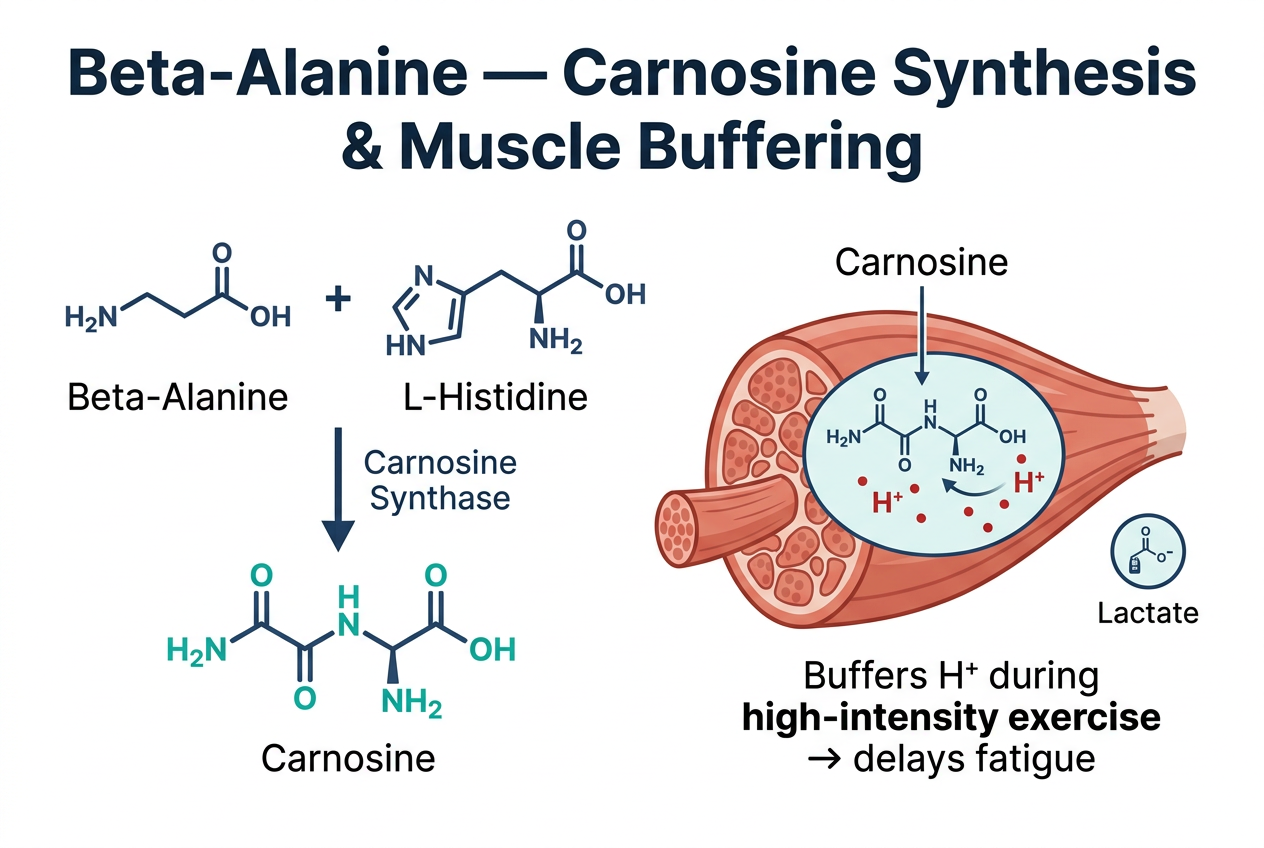
β-Alanine combines with L-histidine via carnosine synthase to form carnosine, which buffers H+ ions in muscle and delays fatigue.
White crystalline amino acid powder. Highly water-soluble.
- Powder
- Capsule
- Tablet
- RTD
Powder is generally preferred for bioavailability or efficacy.
Mechanism of Action
Rate-limiting precursor to carnosine synthesis in skeletal muscle. Elevated carnosine buffers hydrogen ions during high-intensity exercise, delaying fatigue.
Physiological Role
Carnosine acts as an intracellular pH buffer, antioxidant, and anti-glycation agent in type II (fast-twitch) muscle fibers.
Primary Pathways
Performance / Health Relevance
Most beneficial for repeated bouts of high-intensity exercise lasting 60 seconds to 10 minutes. Less relevant for pure strength or ultra-endurance.
Evidence Review
Practical Use & Dosage
- Minimum Effective Dose
- 2g/day
- Optimal Range
- 3.2–6.4g/day split into multiple doses
- Upper / Caution Level
- 6.4g/day
- Timing
- Split into 2–4 doses throughout the day. Timing relative to exercise is irrelevant (chronic loading).
- Best Format
- Sustained-release tablets or powder (split doses)
- Bioavailability
- Rapidly absorbed. Sustained-release formulations reduce paresthesia without compromising carnosine loading.
- Absorption Considerations
- Co-ingestion with meals slows absorption and reduces paresthesia.
Safety & Interactions
Side Effects
- •Paresthesia (harmless tingling, dose-dependent)
Contraindications
- Paresthesia-sensitive individuals at single doses >800 mg (use sustained-release)
- Children under 18 (limited safety data)
Drug Interactions
- •Taurine (competes for same transporter, separate timing)
Who Should Avoid
- •Pregnant or breastfeeding women (limited data)
- •Children under 18 (insufficient safety evidence)
Monitoring
No monitoring needed. Paresthesia is benign and reduces with sustained-release formulations.
Frequently Asked Questions
Auto-generated from indexed evidence — dosage, safety, interactions, and more.
When is Beta-Alanine typically used or indicated?
Beta-Alanine is most commonly used for: High-intensity exercise, Endurance sports, CrossFit, Combat sports. Carnosine acts as an intracellular pH buffer, antioxidant, and anti-glycation agent in type II (fast-twitch) muscle fibers.
How does Beta-Alanine work?
Rate-limiting precursor to carnosine synthesis in skeletal muscle. Elevated carnosine buffers hydrogen ions during high-intensity exercise, delaying fatigue.
What is the recommended dose of Beta-Alanine?
The optimal range is 3.2–6.4g/day split into multiple doses. with a minimum effective dose of 2g/day. Best taken: Split into 2–4 doses throughout the day. Timing relative to exercise is irrelevant (chronic loading).. Upper / caution level: 6.4g/day.
What are the side effects of Beta-Alanine?
Reported side effects include: Paresthesia (harmless tingling, dose-dependent). Monitoring: No monitoring needed. Paresthesia is benign and reduces with sustained-release formulations.
Does Beta-Alanine interact with medications?
Known or theoretical interactions: Taurine (competes for same transporter, separate timing). Always check with a clinician before combining with prescription medication.
Who should avoid Beta-Alanine?
Beta-Alanine is generally not recommended for: Pregnant or breastfeeding women (limited data); Children under 18 (insufficient safety evidence); Paresthesia-sensitive individuals at single doses >800 mg (use sustained-release); and Children under 18 (limited safety data).
How strong is the evidence for Beta-Alanine?
Evidence level: Strong (overall score 78/100), based on 3 indexed studies on SuppIndex.
Research & References (3)
Beta-alanine supplementation to improve exercise capacity and performance
Meta-analysis of 40 studies confirming beta-alanine improves exercise capacity, particularly in activities lasting 0.5–10 minutes.
International Society of Sports Nutrition position stand: Beta-Alanine
ISSN consensus statement on beta-alanine efficacy, dosing, safety and mechanisms.
Effect of beta-alanine supplementation on high-intensity exercise performance
Updated meta-analysis quantifying beta-alanine effect on high-intensity exercise across 40+ trials.
Trademark Ingredients

Related Ingredients
Other top-rated ingredients in Amino Acids.
L-Leucine
82/100Essential BCAA that activates mTORC1 via Sestrin2 sensing, driving phosphorylation of S6K1 and 4E-BP1, initiating cap-dependent translation and muscle protein synthesis.
EAA Blend
78/100Free-form blend of 9 EAAs (Leu, Ile, Val, Lys, Met, Phe, Thr, Trp, His) at evidence-based ratios; bypasses gastric digestion for rapid plasma aminoacidaemia.
BCAA (Branched-Chain Amino Acids)
76/100Meta‑analyses of randomized trials report that BCAA supplementation reduces blood creatine kinase after damaging exercise and can reduce delayed onset muscle soreness in the short term. Individual trials in older or clinical populations using leucine‑enriched BCAA formulas have shown increases in lean mass over 12 weeks; however, functional benefits are not consistently demonstrated and some positive trials are part of multifactorial interventions.
Research Overview
Strong EvidenceCite this ingredient
One-click citation export in APA, MLA, Chicago, BibTeX, or HTML. The URL below is stable and safe to link.
Stable URL
https://thesuppindex.com/ingredients/beta-alanine
SuppIndex. (2026). Beta-Alanine: Evidence summary, dosage and clinical studies. Retrieved October 23, 2026, from https://thesuppindex.com/ingredients/beta-alanine
Based on 3 indexed studies · Evidence level: Strong.
Goal Ratings
Stack Compatibility
Synergistic with creatine and sodium bicarbonate for buffering capacity.
Related evidence
Compare Beta-Alanine with other researched ingredients.
- L-Citrulline— A non-proteinogenic amino acid recycled through the urea cyc…
- Creatine Monohydrate— A naturally occurring nitrogenous organic acid that facilita…
- Taurine— A β-amino sulfonic acid (not incorporated into protein) that…
Last reviewed Feb 2024