
Creatine Monohydrate
Also known as: Creatine, Cr, Methyl Guanidine-Acetic Acid
A naturally occurring nitrogenous organic acid that facilitates recycling of adenosine triphosphate (ATP) in muscle and brain tissue via the phosphocreatine shuttle.
Last reviewed: 2024-01-15 · 5 indexed studies
Set your location for accurate regulatory status
Saved on this device — no sign-in needed.
Overview
Creatine monohydrate is one of the most well-researched and effective sports nutrition supplements available. It has been shown to increase strength, power output, and lean body mass across hundreds of human clinical trials.
Mechanism & Function
Creatine · C₄H₉N₃O₂ — source: PubChem CID 586
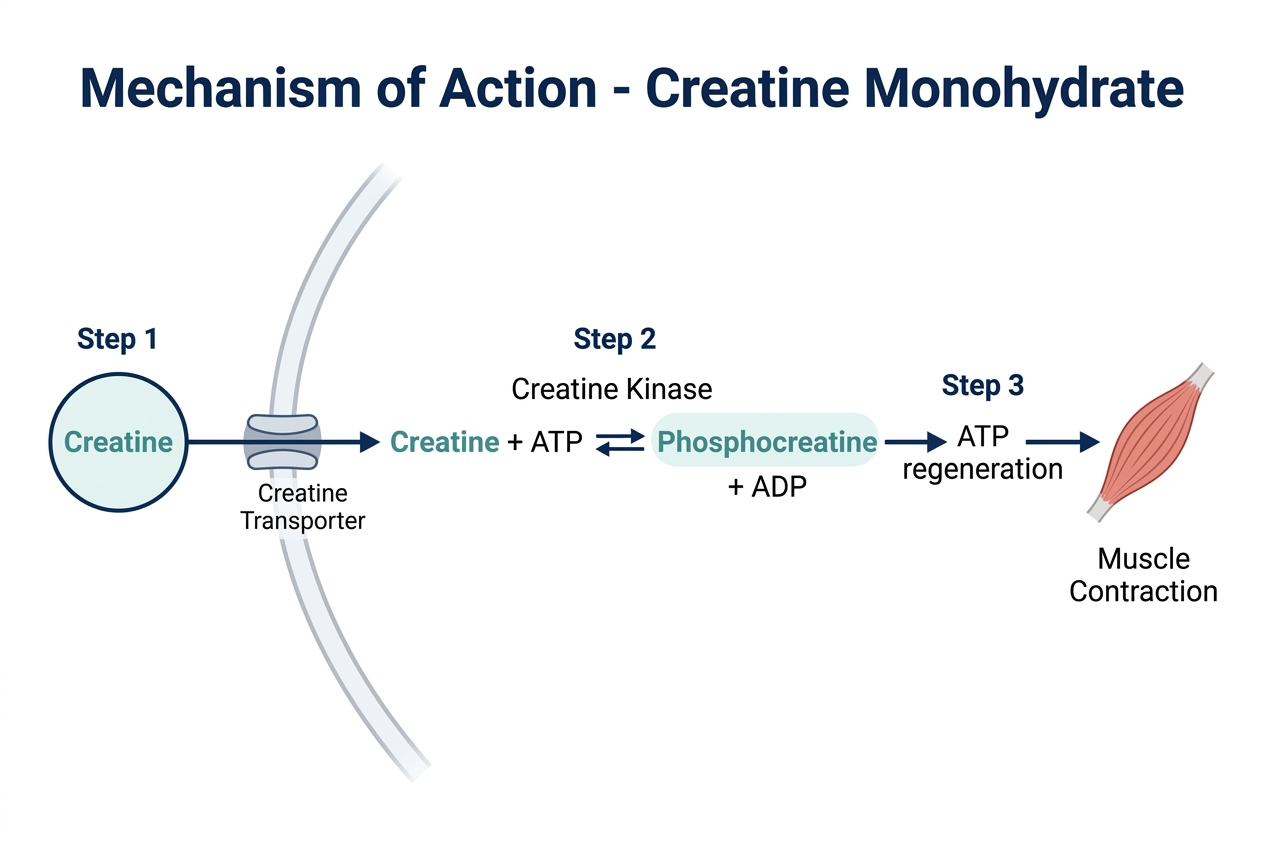
The phosphocreatine shuttle: creatine is transported into muscle, phosphorylated by creatine kinase, then donates its phosphate to regenerate ATP during high-intensity contraction.
Odorless white crystalline powder. Fully water-dispersible at body temperature.
- Powder
- Capsule
- Tablet
- RTD
Powder is generally preferred for bioavailability or efficacy.
Mechanism of Action
Increases phosphocreatine stores in muscles, enabling faster ATP regeneration during high-intensity exercise. Also acts as an osmolyte, drawing water into muscle cells and upregulating mTOR signaling.
Physiological Role
Endogenous creatine synthesis occurs in the liver, kidneys, and pancreas from arginine, glycine, and methionine. ~95% is stored in skeletal muscle.
Primary Pathways
Performance / Health Relevance
Directly enhances high-intensity exercise capacity, increases maximal strength and power, and accelerates muscle hypertrophy when combined with resistance training.
Evidence Review
Practical Use & Dosage
- Minimum Effective Dose
- 3g/day
- Optimal Range
- 3–5g/day
- Upper / Caution Level
- 10g/day (no known toxicity at higher doses but unnecessary)
- Timing
- Any time of day; post-workout may have marginal advantage
- Best Format
- Micronized monohydrate powder
- Bioavailability
- Near 100% oral bioavailability. Monohydrate is the gold standard — no other form has demonstrated superiority.
- Absorption Considerations
- Co-ingestion with carbohydrates or protein may enhance muscle uptake via insulin-mediated transport.
Safety & Interactions
Side Effects
- •Transient water retention (1–2kg)
- •Occasional GI discomfort at high doses
Contraindications
- Pre-existing kidney disease (consult physician)
Drug Interactions
- •NSAIDs (theoretical, monitor renal function)
Who Should Avoid
- •Individuals with impaired renal function without medical supervision
Monitoring
No routine monitoring needed in healthy individuals. Consider baseline renal panel if pre-existing concerns.
Frequently Asked Questions
Auto-generated from indexed evidence — dosage, safety, interactions, and more.
When is Creatine Monohydrate typically used or indicated?
Creatine Monohydrate is most commonly used for: Strength training, Power sports, Cognitive support, Muscle recovery. Endogenous creatine synthesis occurs in the liver, kidneys, and pancreas from arginine, glycine, and methionine. ~95% is stored in skeletal muscle.
How does Creatine Monohydrate work?
Increases phosphocreatine stores in muscles, enabling faster ATP regeneration during high-intensity exercise. Also acts as an osmolyte, drawing water into muscle cells and upregulating mTOR signaling.
What is the recommended dose of Creatine Monohydrate?
The optimal range is 3–5g/day. with a minimum effective dose of 3g/day. Best taken: Any time of day; post-workout may have marginal advantage. Upper / caution level: 10g/day (no known toxicity at higher doses but unnecessary).
What are the side effects of Creatine Monohydrate?
Reported side effects include: Transient water retention (1–2kg); and Occasional GI discomfort at high doses. Monitoring: No routine monitoring needed in healthy individuals. Consider baseline renal panel if pre-existing concerns.
Does Creatine Monohydrate interact with medications?
Known or theoretical interactions: NSAIDs (theoretical, monitor renal function). Always check with a clinician before combining with prescription medication.
Who should avoid Creatine Monohydrate?
Creatine Monohydrate is generally not recommended for: Individuals with impaired renal function without medical supervision; and Pre-existing kidney disease (consult physician).
How strong is the evidence for Creatine Monohydrate?
Evidence level: Strong (overall score 94/100), based on 5 indexed studies on SuppIndex.
Research & References (5)
Effect of creatine supplementation on body composition and performance: a meta-analysis
Meta-analysis of 100 randomised, placebo-controlled studies comparing creatine with placebo for body composition and exercise performance.
Effects of creatine supplementation and resistance training on muscle strength and weightlifting performance
Review of studies combining creatine with resistance training.
International Society of Sports Nutrition position stand: safety and efficacy of creatine supplementation in exercise, sport, and medicine
Expert position stand (narrative, not a formal systematic review) concluding creatine monohydrate is the most effective nutritional supplement for high-intensity exercise capacity and lean mass, and is safe at recommended doses.
Effects of creatine supplementation on cognitive function of healthy individuals: a systematic review of randomized controlled trials
Systematic review of 6 RCTs (281 people) on oral creatine and cognition in healthy individuals.
Creatine supplementation and lower limb strength performance: a systematic review and meta-analyses
Meta-analysis of 60 studies (646 creatine vs 651 control participants) on lower-limb strength.
Trademark Ingredients


Related Ingredients
Other top-rated ingredients in Ergogenic Compounds.
Maltodextrin
78/100Short-chain α-1,4 linked glucose polymer that is rapidly hydrolysed by brush-border maltase to glucose; near-equivalent glycaemic response to glucose but lower osmolality at concentration.
Cyclic Dextrin (HBCD)
72/100Produced via cyclic-glucanotransferase action on amylopectin, HBCD forms cluster-like macromolecules ~160 kDa that solubilise at low osmolality (≈4 mOsm/L) and clear the stomach faster than maltodextrin or glucose polymers.
D-Ribose
72/100Randomized controlled trials of oral D-ribose report symptomatic and some echocardiographic improvements in patients with heart failure or coronary artery disease, while results for exercise performance in athletes are mixed or unfavourable. Short-term use as part of a nicotinamide+D-ribose product increased blood NAD+ metabolites in a small crossover trial.
Research Overview
Strong EvidenceCite this ingredient
One-click citation export in APA, MLA, Chicago, BibTeX, or HTML. The URL below is stable and safe to link.
Stable URL
https://thesuppindex.com/ingredients/creatine-monohydrate
SuppIndex. (2026). Creatine Monohydrate: Evidence summary, dosage and clinical studies. Retrieved October 24, 2026, from https://thesuppindex.com/ingredients/creatine-monohydrate
Based on 5 indexed studies · Evidence level: Strong.
Goal Ratings
Stack Compatibility
Synergistic with beta-alanine, HMB, and protein. Caffeine co-ingestion does not impair creatine loading.
Products (2)
Thorne
Creatine
Momentous
Creatine Monohydrate