
Beetroot Extract
Also known as: Beta vulgaris Extract, Beet Juice Powder, Dietary Nitrate, Red Beet Extract
Concentrated source of dietary inorganic nitrate that undergoes serial reduction via oral microbiome (NO₃⁻ → NO₂⁻) and tissue-level reduction (NO₂⁻ → NO) through the oxygen-independent nitrate-nitrite-NO pathway, enhancing blood flow and exercise efficiency.
Last reviewed: 2024-08-01 · 3 indexed studies
Set your location for accurate regulatory status
Saved on this device — no sign-in needed.
Overview
Beetroot Extract provides concentrated dietary nitrate (NO₃⁻) that is converted to nitric oxide through the nitrate-nitrite-NO pathway — a completely separate and complementary pathway to the arginine-eNOS route used by citrulline and Nitrosigine. This dual-pathway NO production makes beetroot a unique and evidence-backed endurance and pump ingredient.
Mechanism & Function
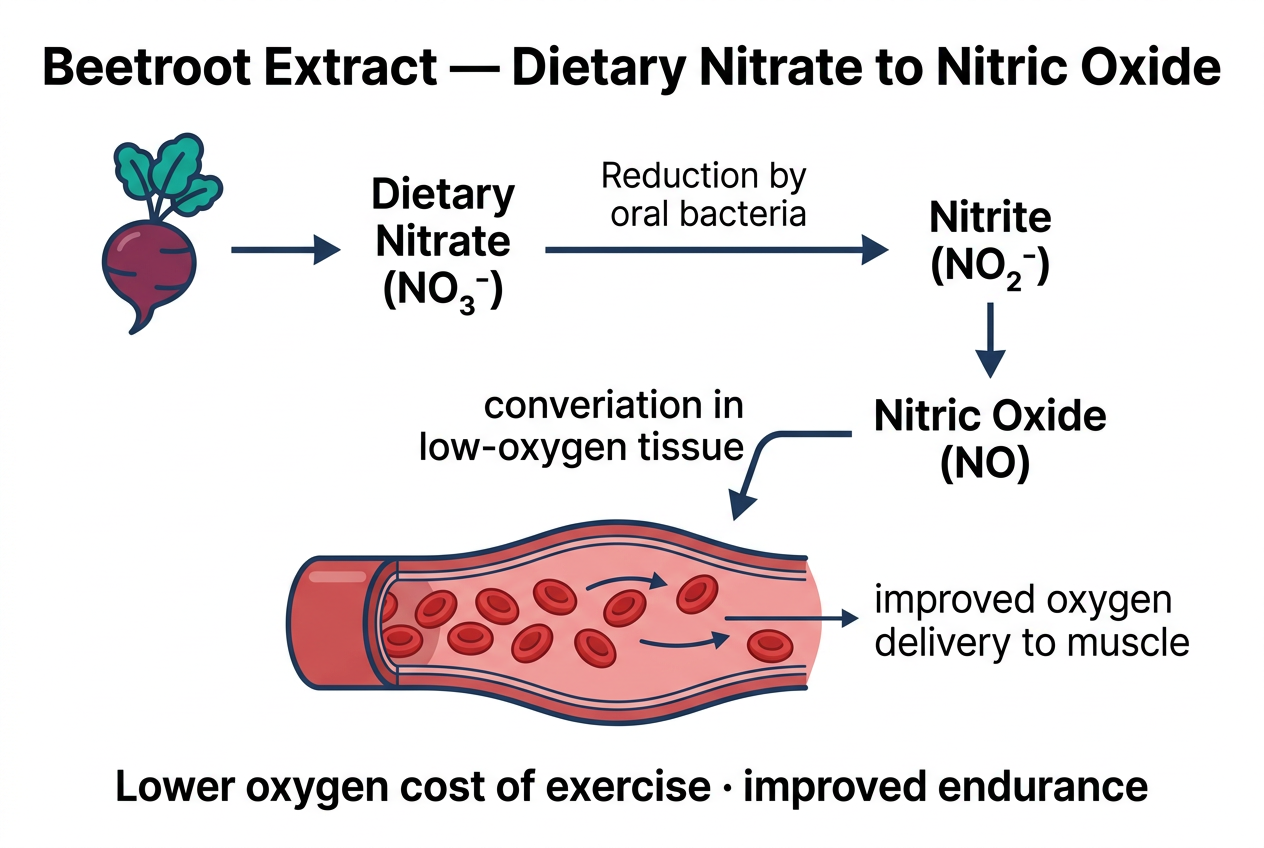
Dietary nitrate is reduced by oral bacteria to nitrite, then to nitric oxide in low-oxygen tissue — lowering the oxygen cost of exercise.
Deep magenta freeze-dried beetroot. Earthy, slightly sweet flavor.
- Powder
- Capsule
- RTD
- Gummy
Powder is generally preferred for bioavailability or efficacy.
Mechanism of Action
Dietary nitrate is absorbed in the upper GI tract, concentrated in saliva by the salivary glands (enterosalivary circulation), and reduced to nitrite (NO₂⁻) by commensal oral bacteria (Veillonella, Actinomyces). Swallowed nitrite is further reduced to NO in the acidic stomach environment and in hypoxic/acidic tissues (exercising muscle). This pathway is oxygen-independent — meaning it produces MORE NO precisely when and where it's most needed (during intense exercise when oxygen is depleted). This is fundamentally different from the eNOS pathway which requires oxygen.
Physiological Role
Dietary nitrate provides a reservoir for the non-enzymatic, oxygen-independent NO production pathway. This pathway is a backup and complement to eNOS, becoming increasingly important during exercise-induced hypoxia and acidosis when eNOS efficiency declines.
Primary Pathways
Performance / Health Relevance
Consistently shown to reduce the oxygen cost of submaximal exercise by 3–5%, extend time-to-exhaustion by 15–25% in moderate-intensity exercise, and improve 10km time trial performance. Effects are most pronounced in recreational athletes and at moderate intensities. Also reduces resting blood pressure by 3–10 mmHg.
Evidence Review
Practical Use & Dosage
- Minimum Effective Dose
- 300mg nitrate (~5 mmol) or ~500mg beetroot extract (standardized)
- Optimal Range
- 400–800mg nitrate (~6.4–12.8 mmol) or 1000–2000mg beetroot extract
- Upper / Caution Level
- 1200mg nitrate/day
- Timing
- 2–3 hours pre-exercise for acute performance; daily for chronic benefits (blood pressure). Nitrate levels peak at 2–3 hours post-ingestion.
- Best Format
- Concentrated beetroot juice (e.g., Beet It Sport shots) or standardized beetroot extract powder (≥2% nitrate content)
- Bioavailability
- Oral microbiome is CRITICAL — antibacterial mouthwash eliminates the nitrate → nitrite conversion and completely abolishes the performance benefits. Avoid mouthwash around dosing. Nitrate content varies dramatically between products — always check standardization.
- Absorption Considerations
- Do NOT use antibacterial mouthwash before or after ingestion. Vitamin C co-ingestion may enhance gastric nitrite → NO conversion. Allow 2–3 hours for peak plasma nitrite levels.
Safety & Interactions
Side Effects
- •Beeturia (red/pink urine — harmless)
- •Red stools (harmless)
- •GI discomfort at very high doses
- •Temporary drop in blood pressure
Contraindications
- Kidney stones (oxalate content in whole beet products)
- Severe hypotension
Drug Interactions
- •Antihypertensives (additive blood pressure reduction)
- •PDE5 inhibitors (additive vasodilation)
- •Anticoagulants (minor theoretical interaction)
Who Should Avoid
- •Those prone to calcium oxalate kidney stones (whole beet; less concern with purified nitrate extracts)
- •Individuals with severe low blood pressure
Monitoring
Red urine (beeturia) is normal and harmless. Monitor blood pressure if on antihypertensives. Ensure product is standardized for nitrate content.
Frequently Asked Questions
Auto-generated from indexed evidence — dosage, safety, interactions, and more.
When is Beetroot Extract typically used or indicated?
Beetroot Extract is most commonly used for: Endurance performance, Natural NO production, Blood pressure support, Oxygen efficiency. Dietary nitrate provides a reservoir for the non-enzymatic, oxygen-independent NO production pathway. This pathway is a backup and complement to eNOS, becoming increasingly important during exercise-induced hypoxia and acidosis when eNOS efficiency declines.
How does Beetroot Extract work?
Dietary nitrate is absorbed in the upper GI tract, concentrated in saliva by the salivary glands (enterosalivary circulation), and reduced to nitrite (NO₂⁻) by commensal oral bacteria (Veillonella, Actinomyces). Swallowed nitrite is further reduced to NO in the acidic stomach environment and in hypoxic/acidic tissues (exercising muscle). This pathway is oxygen-independent — meaning it produces MORE NO precisely when and where it's most needed (during intense exercise when oxygen is depleted). This is fundamentally different from the eNOS pathway which requires oxygen.
What is the recommended dose of Beetroot Extract?
The optimal range is 400–800mg nitrate (~6.4–12.8 mmol) or 1000–2000mg beetroot extract. with a minimum effective dose of 300mg nitrate (~5 mmol) or ~500mg beetroot extract (standardized). Best taken: 2–3 hours pre-exercise for acute performance; daily for chronic benefits (blood pressure). Nitrate levels peak at 2–3 hours post-ingestion.. Upper / caution level: 1200mg nitrate/day.
What are the side effects of Beetroot Extract?
Reported side effects include: Beeturia (red/pink urine — harmless); Red stools (harmless); GI discomfort at very high doses; and Temporary drop in blood pressure. Monitoring: Red urine (beeturia) is normal and harmless. Monitor blood pressure if on antihypertensives. Ensure product is standardized for nitrate content.
Does Beetroot Extract interact with medications?
Known or theoretical interactions: Antihypertensives (additive blood pressure reduction); PDE5 inhibitors (additive vasodilation); and Anticoagulants (minor theoretical interaction). Always check with a clinician before combining with prescription medication.
Who should avoid Beetroot Extract?
Beetroot Extract is generally not recommended for: Those prone to calcium oxalate kidney stones (whole beet; less concern with purified nitrate extracts); Individuals with severe low blood pressure; Kidney stones (oxalate content in whole beet products); and Severe hypotension.
How strong is the evidence for Beetroot Extract?
Evidence level: Strong (overall score 80/100), based on 3 indexed studies on SuppIndex.
Research & References (3)
Dietary nitrate supplementation and exercise performance: a systematic review and meta-analysis
Meta-analysis of 76 studies confirming dietary nitrate (primarily from beetroot) improves endurance exercise performance, reduces oxygen cost of exercise by 3–5%, and enhances time-to-exhaustion. Effects most consistent in recreational athletes.
Effects of dietary nitrate on blood pressure: a systematic review and meta-analysis
Meta-analysis of 16 RCTs showing inorganic nitrate/beetroot juice supplementation reduces systolic BP by ~4.4 mmHg and diastolic BP by ~1.1 mmHg. Dose-response relationship confirmed.
Influence of dietary nitrate supplementation on high-intensity intermittent running performance
Beetroot juice providing ~6.4 mmol nitrate improved repeated sprint performance and high-intensity intermittent exercise capacity in team-sport athletes.
Trademark Ingredients

BeetElite®
Manufacturer: HumanN / Neogenis
3 clinical studies/evidence points

Beet It Sport®
Manufacturer: James White Drinks
3 clinical studies/evidence points
VitaNOX™ Beetroot
Manufacturer: NuLiv Science
1 clinical studies/evidence points
Related Ingredients
Other top-rated ingredients in Pump and Performance Ingredients.
Nitrosigine®
82/100Inositol-stabilized arginine silicate complex that provides sustained elevation of plasma arginine (up to 6 hours) and silicon, enhancing eNOS-mediated nitric oxide production, vascular compliance, and cognitive flexibility during physical exertion.
Citrulline Malate
78/100Salt of L-citrulline and DL-malic acid (commonly 2:1); citrulline raises plasma arginine and NO; malate enters the Krebs cycle and may buffer fatigue.
L-Citrulline
74/100A non-proteinogenic amino acid recycled through the urea cycle that elevates plasma L-arginine levels, enhancing endothelial nitric oxide synthase (eNOS) substrate availability and systemic NO production.
Research Overview
Strong EvidenceCite this ingredient
One-click citation export in APA, MLA, Chicago, BibTeX, or HTML. The URL below is stable and safe to link.
Stable URL
https://thesuppindex.com/ingredients/beetroot-extract
SuppIndex. (2026). Beetroot Extract: Evidence summary, dosage and clinical studies. Retrieved October 23, 2026, from https://thesuppindex.com/ingredients/beetroot-extract
Based on 3 indexed studies · Evidence level: Strong.
Goal Ratings
Stack Compatibility
Complementary to citrulline/Nitrosigine since it uses the completely separate nitrate-nitrite-NO pathway. This makes beetroot the ideal addition to any eNOS-based pump stack for true dual-pathway NO production.
Products (3)
HumanN
BeetElite Black Cherry
Beet It Sport
Concentrated Beetroot Shot
Kaged
Pre-Kaged Elite