
Curcumin
Also known as: Diferuloylmethane, Turmeric Extract, Curcuminoids
Polyphenolic compound that modulates NF-κB, COX-2, and multiple inflammatory cascades with demonstrated efficacy comparable to NSAIDs in some osteoarthritis trials, when bioavailability-enhanced formulations are used.
Last reviewed: 2024-07-01 · 2 indexed studies
Set your location for accurate regulatory status
Saved on this device — no sign-in needed.
Overview
Curcumin is the principal curcuminoid of turmeric (Curcuma longa), with potent anti-inflammatory and antioxidant properties rivaling pharmaceutical agents in some clinical comparisons. Its major limitation — poor native bioavailability — is overcome by enhanced formulations.
Mechanism & Function
Curcumin · C₂₁H₂₀O₆ — source: PubChem CID 969516
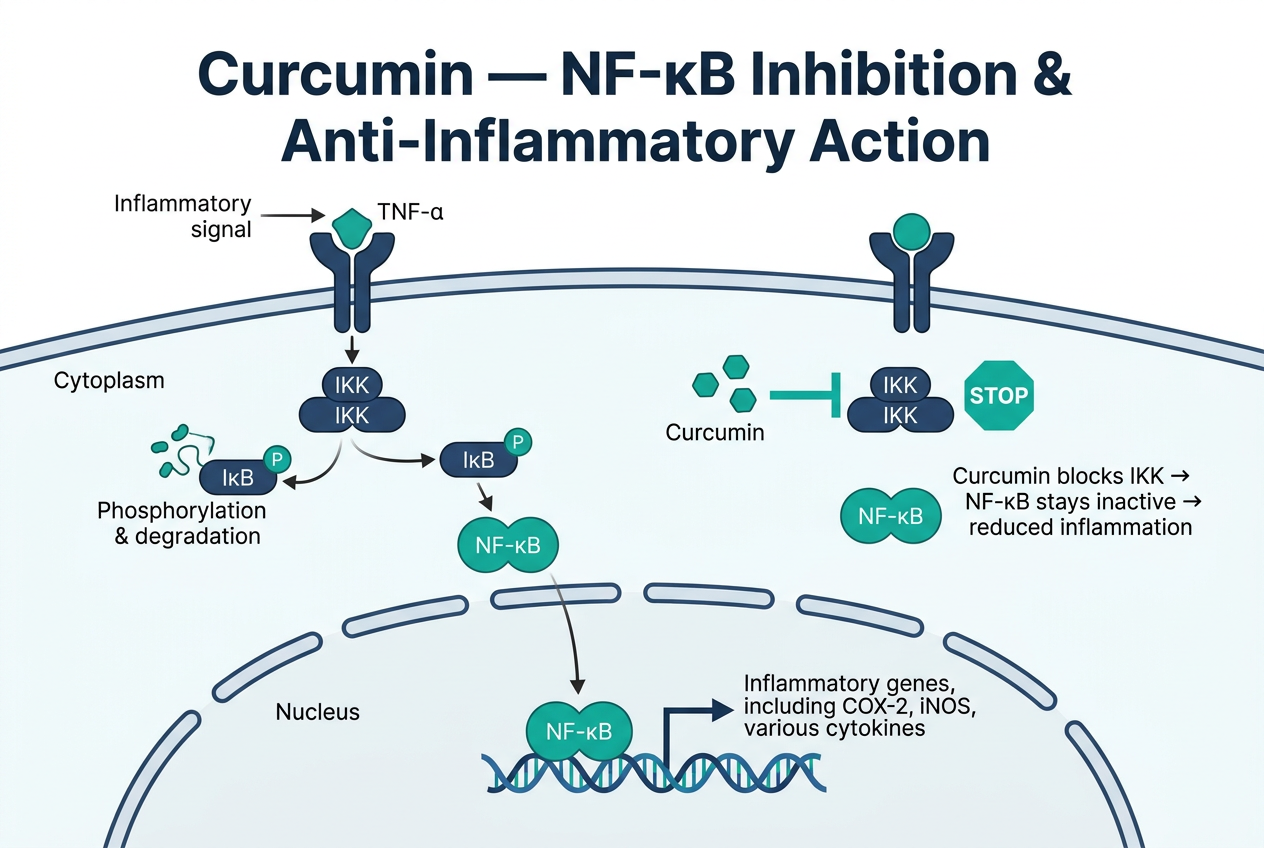
Curcumin inhibits the IKK complex, preventing NF-κB nuclear translocation and downregulating inflammatory genes (COX-2, iNOS, cytokines).
Bright yellow-orange resin/powder. Fat-soluble — paired with phospholipids or piperine for absorption.
- Capsule
- Softgel
- Powder
- Liquid
Softgel is generally preferred for bioavailability or efficacy.
Mechanism of Action
Inhibits NF-κB activation, suppressing transcription of pro-inflammatory cytokines (TNF-α, IL-1β, IL-6). Directly inhibits COX-2 and LOX enzymes. Activates Nrf2 pathway for endogenous antioxidant defense (SOD, catalase, glutathione). Modulates over 100 molecular targets spanning inflammation, apoptosis, and proliferation pathways.
Physiological Role
Not an essential nutrient but a potent dietary bioactive. Modulates systemic inflammation, protects against oxidative damage, and supports healthy inflammatory resolution across joint, cardiovascular, neurological, and GI tissues.
Primary Pathways
Performance / Health Relevance
Reduces DOMS and exercise-induced inflammation. Supports joint comfort during high-volume training. May enhance recovery between sessions by accelerating inflammatory resolution.
Evidence Review
Practical Use & Dosage
- Minimum Effective Dose
- 200mg (enhanced form) or 500mg (with piperine)
- Optimal Range
- 500–1000mg curcuminoids/day (enhanced form)
- Upper / Caution Level
- 2000mg/day curcuminoids
- Timing
- With meals, split AM/PM for sustained levels
- Best Format
- Enhanced-bioavailability form (phytosome, nano, or with piperine)
- Bioavailability
- Native curcumin has <1% bioavailability. Piperine increases by 2000%. Phytosome forms (Meriva) increase 29x. Nano-curcumin forms show 100x+ improvement.
- Absorption Considerations
- Must use bioavailability-enhanced formulation for clinical effect. Fat-soluble — always take with a meal. Piperine co-administration is the most cost-effective enhancement.
Safety & Interactions
Side Effects
- •GI discomfort at high doses
- •Yellow staining of teeth/skin (topical)
- •Mild headache (rare)
Contraindications
- Gallbladder disease (stimulates bile secretion)
- Iron deficiency (may chelate iron)
Drug Interactions
- •Anticoagulants (additive effect)
- •Sulfasalazine (enhanced absorption)
- •Chemotherapy agents (consult oncologist)
Who Should Avoid
- •Those with gallstones or bile duct obstruction
- •Individuals on anticoagulant therapy without medical supervision
Monitoring
Monitor liver enzymes during prolonged high-dose use. Check iron status if supplementing long-term.
Frequently Asked Questions
Auto-generated from indexed evidence — dosage, safety, interactions, and more.
When is Curcumin typically used or indicated?
Curcumin is most commonly used for: Anti-inflammation, Joint support, Antioxidant defense, Recovery. Not an essential nutrient but a potent dietary bioactive. Modulates systemic inflammation, protects against oxidative damage, and supports healthy inflammatory resolution across joint, cardiovascular, neurological, and GI tissues.
How does Curcumin work?
Inhibits NF-κB activation, suppressing transcription of pro-inflammatory cytokines (TNF-α, IL-1β, IL-6). Directly inhibits COX-2 and LOX enzymes. Activates Nrf2 pathway for endogenous antioxidant defense (SOD, catalase, glutathione). Modulates over 100 molecular targets spanning inflammation, apoptosis, and proliferation pathways.
What is the recommended dose of Curcumin?
The optimal range is 500–1000mg curcuminoids/day (enhanced form). with a minimum effective dose of 200mg (enhanced form) or 500mg (with piperine). Best taken: With meals, split AM/PM for sustained levels. Upper / caution level: 2000mg/day curcuminoids.
What are the side effects of Curcumin?
Reported side effects include: GI discomfort at high doses; Yellow staining of teeth/skin (topical); and Mild headache (rare). Monitoring: Monitor liver enzymes during prolonged high-dose use. Check iron status if supplementing long-term.
Does Curcumin interact with medications?
Known or theoretical interactions: Anticoagulants (additive effect); Sulfasalazine (enhanced absorption); and Chemotherapy agents (consult oncologist). Always check with a clinician before combining with prescription medication.
Who should avoid Curcumin?
Curcumin is generally not recommended for: Those with gallstones or bile duct obstruction; Individuals on anticoagulant therapy without medical supervision; Gallbladder disease (stimulates bile secretion); and Iron deficiency (may chelate iron).
How strong is the evidence for Curcumin?
Evidence level: Strong (overall score 85/100), based on 2 indexed studies on SuppIndex.
Research & References (2)
Efficacy of curcumin in management of knee osteoarthritis: a meta-analysis of RCTs
Meta-analysis of 16 RCTs showing curcumin significantly reduces pain (VAS) and improves function (WOMAC) in knee OA, comparable to NSAIDs with fewer side effects.
Curcumin supplementation and delayed onset muscle soreness: a systematic review
Systematic review confirming curcumin supplementation reduces DOMS severity and accelerates recovery of muscle function post-exercise.
Trademark Ingredients




Related Ingredients
Other top-rated ingredients in Botanical Extracts.
Pycnogenol
78/100Standardised pine bark extract delivering procyanidins, catechins, and phenolic acids; raises eNOS-derived NO, scavenges ROS, and supports collagen integrity.
Rhodiola Rosea
76/100Adaptogenic botanical containing rosavins and salidroside that modulate cortisol response, enhance stress resilience, and improve cognitive and physical performance under fatigue conditions.
Citrus Bergamot
74/100Standardised Citrus bergamia juice extract delivering bergamot polyphenolic fraction (BPF) including brutieridin, melitidin, and naringin.
Research Overview
Strong EvidenceCite this ingredient
One-click citation export in APA, MLA, Chicago, BibTeX, or HTML. The URL below is stable and safe to link.
Stable URL
https://thesuppindex.com/ingredients/curcumin
SuppIndex. (2026). Curcumin: Evidence summary, dosage and clinical studies. Retrieved October 23, 2026, from https://thesuppindex.com/ingredients/curcumin
Based on 2 indexed studies · Evidence level: Strong.
Goal Ratings
Stack Compatibility
Piperine is the essential co-factor (2000% absorption boost). Pairs well with omega-3 and collagen for comprehensive joint/recovery stacks.
Products (2)
Thorne
Meriva 500-SF
NOW Foods
Curcumin with BioPerine