
Collagen Peptides
Also known as: Hydrolyzed Collagen, Collagen Hydrolysate, Type I/III Collagen
Enzymatically hydrolyzed type I and III collagen yielding low-molecular-weight peptides (primarily glycine-proline-hydroxyproline tripeptides) that are absorbed intact and stimulate fibroblast collagen synthesis.
Last reviewed: 2024-03-15 · 3 indexed studies
Set your location for accurate regulatory status
Saved on this device — no sign-in needed.
Overview
Collagen peptides are enzymatically hydrolyzed collagen proteins providing bioactive peptides that stimulate fibroblast activity and support connective tissue synthesis throughout the body.
Mechanism & Function
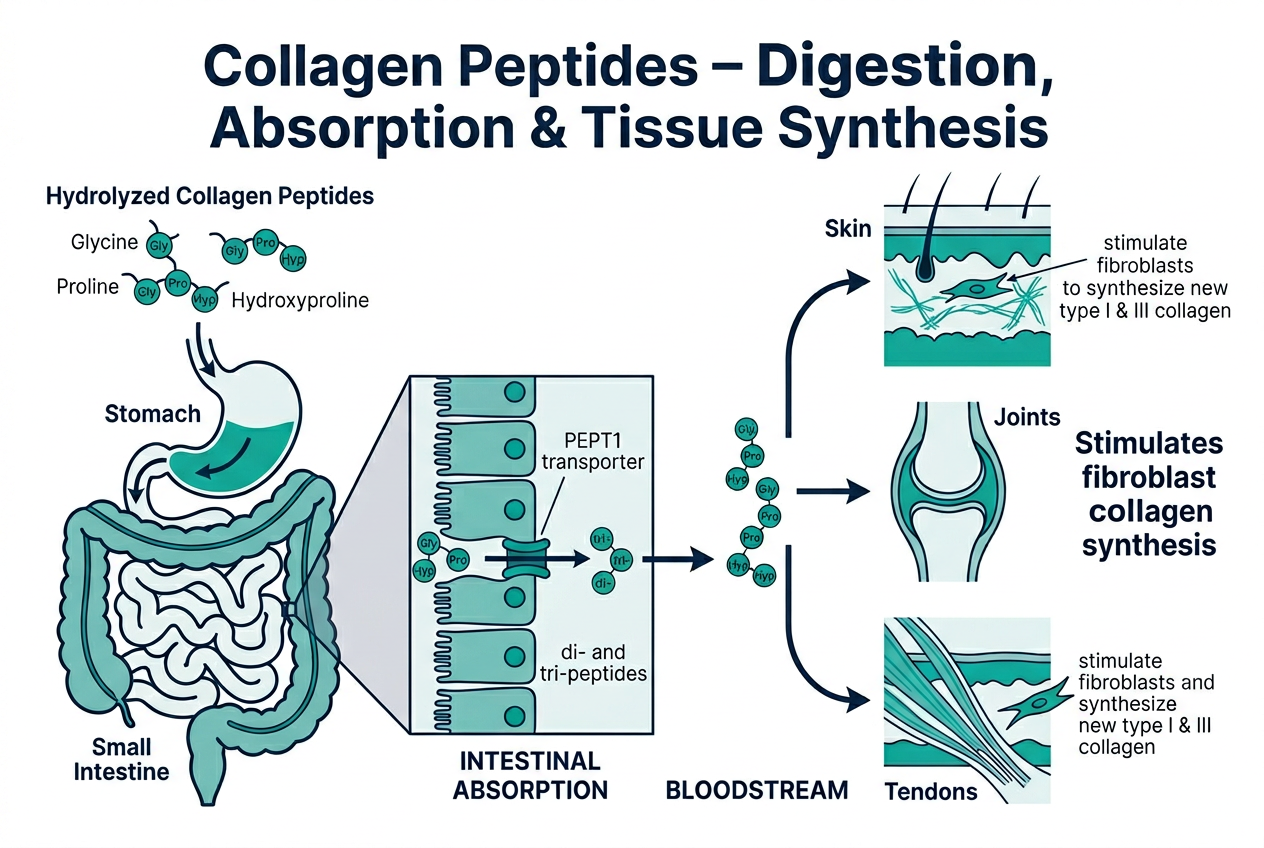
Hydrolyzed peptides are absorbed via the PEPT1 transporter and circulate to skin, joints and tendons, where they stimulate fibroblast collagen synthesis.
Cream/off-white hydrolyzed peptide powder. Cold-water soluble, near-tasteless.
- Powder
- Capsule
- RTD
- Liquid
- Gummy
Powder is generally preferred for bioavailability or efficacy.
Mechanism of Action
Di- and tripeptides containing hydroxyproline are absorbed intact via PepT1 transporter. These peptides accumulate in cartilage and skin, acting as ligands for fibroblast receptors that upregulate endogenous collagen synthesis.
Physiological Role
Collagen constitutes ~30% of total body protein. Provides structural framework for skin, tendons, ligaments, cartilage, and bone. Endogenous synthesis declines ~1% per year after age 25.
Primary Pathways
Performance / Health Relevance
Athletes supplementing collagen peptides with vitamin C before exercise show enhanced collagen synthesis rates in tendons and ligaments, potentially reducing injury risk.
Evidence Review
Practical Use & Dosage
- Minimum Effective Dose
- 5g/day
- Optimal Range
- 10–15g/day hydrolyzed collagen peptides
- Upper / Caution Level
- 40g/day (no safety concerns but unnecessary)
- Timing
- 30–60 minutes before exercise with 50mg vitamin C for connective tissue targeting
- Best Format
- Hydrolyzed peptide powder (dissolves in hot or cold liquid)
- Bioavailability
- Hydrolyzed peptides show 90%+ absorption. Larger molecular weight gelatin requires further digestion and shows lower bioactive peptide delivery.
- Absorption Considerations
- Vitamin C is essential for collagen cross-linking. Co-ingestion significantly enhances collagen synthesis response.
Safety & Interactions
Side Effects
- •Mild bloating (rare)
- •Unpleasant taste in unflavored forms
Contraindications
- Source allergy (bovine, marine, or porcine — check label)
- Phenylketonuria (some products contain phenylalanine)
Drug Interactions
- •Calcium-sensitive medications (high-dose marine collagen contains trace calcium)
Who Should Avoid
- •Those with fish/shellfish allergy (check source — bovine/marine)
Monitoring
No monitoring needed. Effects on joint pain typically take 8–12 weeks.
Frequently Asked Questions
Auto-generated from indexed evidence — dosage, safety, interactions, and more.
When is Collagen Peptides typically used or indicated?
Collagen Peptides is most commonly used for: Joint health, Tendon recovery, Skin elasticity, Bone support. Collagen constitutes ~30% of total body protein. Provides structural framework for skin, tendons, ligaments, cartilage, and bone. Endogenous synthesis declines ~1% per year after age 25.
How does Collagen Peptides work?
Di- and tripeptides containing hydroxyproline are absorbed intact via PepT1 transporter. These peptides accumulate in cartilage and skin, acting as ligands for fibroblast receptors that upregulate endogenous collagen synthesis.
What is the recommended dose of Collagen Peptides?
The optimal range is 10–15g/day hydrolyzed collagen peptides. with a minimum effective dose of 5g/day. Best taken: 30–60 minutes before exercise with 50mg vitamin C for connective tissue targeting. Upper / caution level: 40g/day (no safety concerns but unnecessary).
What are the side effects of Collagen Peptides?
Reported side effects include: Mild bloating (rare); and Unpleasant taste in unflavored forms. Monitoring: No monitoring needed. Effects on joint pain typically take 8–12 weeks.
Does Collagen Peptides interact with medications?
Known or theoretical interactions: Calcium-sensitive medications (high-dose marine collagen contains trace calcium). Always check with a clinician before combining with prescription medication.
Who should avoid Collagen Peptides?
Collagen Peptides is generally not recommended for: Those with fish/shellfish allergy (check source — bovine/marine); Source allergy (bovine, marine, or porcine — check label); and Phenylketonuria (some products contain phenylalanine).
How strong is the evidence for Collagen Peptides?
Evidence level: Moderate (overall score 70/100), based on 3 indexed studies on SuppIndex.
Research & References (3)
Vitamin C–enriched gelatin supplementation before activity augments collagen synthesis
15g gelatin with 50mg vitamin C taken 1 hour before exercise doubled collagen synthesis rate in engineered ligaments.
Collagen peptide supplementation and joint pain: a meta-analysis
Meta-analysis of 15 RCTs showing collagen peptides significantly reduce joint pain in osteoarthritis and activity-related joint discomfort.
Effect of oral collagen peptide supplementation on skin moisture and elasticity: meta-analysis
Meta-analysis of 19 RCTs of hydrolysed collagen on skin endpoints.
Trademark Ingredients
Related Ingredients
Other top-rated ingredients in Joint and Recovery Ingredients.
Glucosamine Sulfate
62/100An amino monosaccharide serving as the essential substrate for biosynthesis of glycosaminoglycans and proteoglycans, the structural macromolecules of articular cartilage extracellular matrix.
Tart Cherry Extract
58/100A polyphenol-rich extract of Prunus cerasus containing anthocyanins (cyanidin glycosides) and trace melatonin, exhibiting anti-inflammatory, antioxidant, and uricosuric properties.
TUDCA
56/100Conjugate of taurine and ursodeoxycholic acid; reduces cytotoxic bile acid pool, protects mitochondria, and inhibits ER stress-induced apoptosis.
Research Overview
Moderate EvidenceCite this ingredient
One-click citation export in APA, MLA, Chicago, BibTeX, or HTML. The URL below is stable and safe to link.
Stable URL
https://thesuppindex.com/ingredients/collagen-peptides
SuppIndex. (2026). Collagen Peptides: Evidence summary, dosage and clinical studies. Retrieved October 23, 2026, from https://thesuppindex.com/ingredients/collagen-peptides
Based on 3 indexed studies · Evidence level: Moderate.
Goal Ratings
Stack Compatibility
Always pair with vitamin C (50–100mg). Combines well with glucosamine and hyaluronic acid for comprehensive joint support.
Related evidence
Compare Collagen Peptides with other researched ingredients.
- Hyaluronic Acid— A high-molecular-weight polysaccharide of alternating glucur…
- Glycine— Simplest amino acid acting as an inhibitory neurotransmitter…
Last reviewed Mar 2024
Products (1)
Momentous
Collagen Peptides