
Vitamin D3
Also known as: Cholecalciferol, Vitamin D, Sunshine Vitamin
A secosteroid prohormone converted to calcitriol (1,25-dihydroxyvitamin D), functioning as a nuclear hormone receptor ligand regulating >1000 genes.
Last reviewed: 2024-01-15 · 3 indexed studies
Set your location for accurate regulatory status
Saved on this device — no sign-in needed.
Overview
Vitamin D3 (cholecalciferol) is a fat-soluble secosteroid essential for calcium absorption, bone mineralization, immune regulation, and neuromuscular function. Deficiency is highly prevalent globally.
Mechanism & Function
Cholecalciferol (D3) · C₂₇H₄₄O — source: PubChem CID 5280795
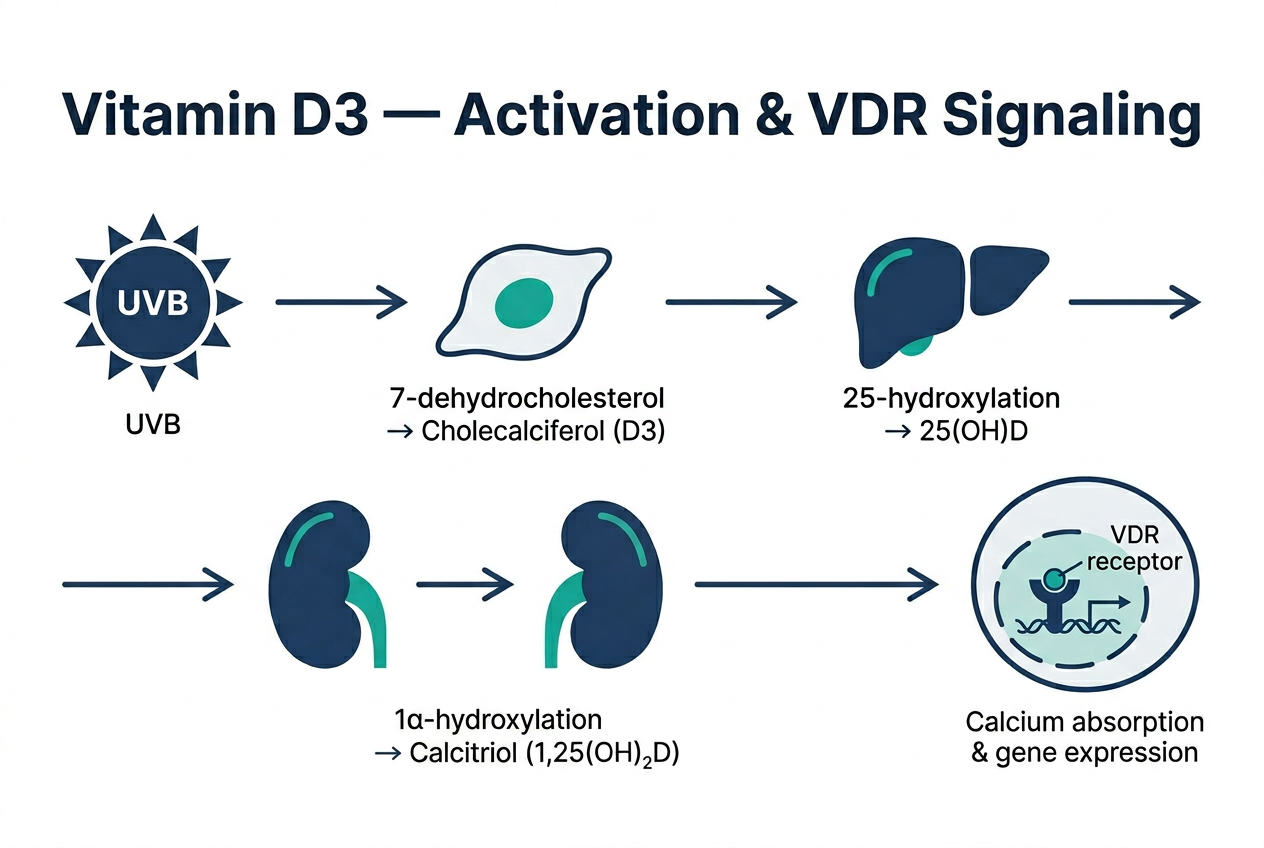
D3 is hydroxylated in the liver and kidney to calcitriol, which binds the vitamin D receptor (VDR) to regulate calcium absorption and gene expression.
Cholecalciferol dissolved in MCT or olive oil — fat-soluble, light-sensitive.
- Softgel
- Liquid
- Liquid Cap
- Capsule
- Sublingual
Softgel is generally preferred for bioavailability or efficacy.
Mechanism of Action
Converted to calcitriol which acts as a steroid hormone, binding to vitamin D receptors in nearly every tissue to regulate calcium homeostasis, immune function, and gene expression.
Physiological Role
Regulates calcium and phosphorus absorption, bone mineralization, innate and adaptive immune responses, and cellular differentiation.
Primary Pathways
Performance / Health Relevance
Adequate vitamin D status correlates with improved muscle function, reduced injury risk in athletes, and faster recovery from training.
Evidence Review
Compare Vitamin D Forms
Full comparison2 vitamin d forms are indexed. Bioavailability, clinical evidence, and best-use cases differ meaningfully between them.
| Form | Evidence |
|---|---|
Vitamin D3This page D3 is 87% more potent than D2 at raising serum 25(OH)D. Oil-based delivery enhances absorption. | 91/100 |
| Vitamin D2 (Ergocalciferol) Fat-soluble vitamin; absorption is enhanced when consumed with dietary fat. Requires hydroxylation in liver and kidney for activation. | 65/100 |
Practical Use & Dosage
- Minimum Effective Dose
- 1,000 IU/day
- Optimal Range
- 2,000–5,000 IU/day depending on baseline levels
- Upper / Caution Level
- 10,000 IU/day (chronic use requires monitoring)
- Timing
- With a fat-containing meal for optimal absorption
- Best Format
- Softgel or liquid with oil base
- Bioavailability
- D3 is 87% more potent than D2 at raising serum 25(OH)D. Oil-based delivery enhances absorption.
- Absorption Considerations
- Requires dietary fat for absorption. Magnesium is a cofactor for conversion to active form.
Safety & Interactions
Side Effects
- •Hypercalcemia at very high doses
- •Nausea (rare, dose-dependent)
Contraindications
- Hypercalcemia
- Granulomatous diseases (sarcoidosis)
Drug Interactions
- •Thiazide diuretics
- •Steroids
- •Statins
Who Should Avoid
- •Those with hypercalcemia or calcium kidney stones without physician guidance
Monitoring
Check serum 25(OH)D every 3–6 months. Target 40–60 ng/mL. Pair with K2 to direct calcium to bones.
Frequently Asked Questions
Auto-generated from indexed evidence — dosage, safety, interactions, and more.
When is Vitamin D3 typically used or indicated?
Vitamin D3 is most commonly used for: Bone health, Immune function, Mood regulation, Muscle function. Regulates calcium and phosphorus absorption, bone mineralization, innate and adaptive immune responses, and cellular differentiation.
How does Vitamin D3 work?
Converted to calcitriol which acts as a steroid hormone, binding to vitamin D receptors in nearly every tissue to regulate calcium homeostasis, immune function, and gene expression.
What is the recommended dose of Vitamin D3?
The optimal range is 2,000–5,000 IU/day depending on baseline levels. with a minimum effective dose of 1,000 IU/day. Best taken: With a fat-containing meal for optimal absorption. Upper / caution level: 10,000 IU/day (chronic use requires monitoring).
What are the side effects of Vitamin D3?
Reported side effects include: Hypercalcemia at very high doses; and Nausea (rare, dose-dependent). Monitoring: Check serum 25(OH)D every 3–6 months. Target 40–60 ng/mL. Pair with K2 to direct calcium to bones.
Does Vitamin D3 interact with medications?
Known or theoretical interactions: Thiazide diuretics; Steroids; and Statins. Always check with a clinician before combining with prescription medication.
Who should avoid Vitamin D3?
Vitamin D3 is generally not recommended for: Those with hypercalcemia or calcium kidney stones without physician guidance; Hypercalcemia; and Granulomatous diseases (sarcoidosis).
How strong is the evidence for Vitamin D3?
Evidence level: Strong (overall score 91/100), based on 3 indexed studies on SuppIndex.
Research & References (3)
Vitamin D supplementation and prevention of acute respiratory infections
Individual participant data meta-analysis of 25 RCTs showing vitamin D supplementation reduced the risk of acute respiratory infections.
Vitamin D supplementation and musculoskeletal health: meta-analysis
Meta-analysis of vitamin D RCTs on muscle strength and falls.
Effect of vitamin D3 supplementation on serum 25(OH)D: dose-response meta-analysis
Quantifies the dose-response between oral D3 and serum 25-hydroxyvitamin D rise.
Related Ingredients
Other top-rated ingredients in Vitamins.
Vitamin B3 (Niacin)
80/100Niacin is a precursor to nicotinamide adenine dinucleotide (NAD+) and nicotinamide adenine dinucleotide phosphate (NADP+), two critical coenzymes involved in over 400 enzymatic reactions in the body. These reactions are central to energy metabolism, DNA repair, and antioxidant defense. Pharmacological doses of nicotinic acid have a well-established role in lowering LDL cholesterol and triglycerides and raising HDL cholesterol, primarily through inhibiting hepatic VLDL synthesis and reducing fatty acid mobilization. Nicotinamide, while also a source of NAD+, does not exert the same hypolipidemic effects but is crucial for various cellular processes and has shown promise in certain dermatological conditions and neurological contexts at higher doses.
Vitamin B9 (L-Methylfolate / 5-MTHF)
75/100L-Methylfolate is the principal circulating form of folate and the only form that can cross the blood-brain barrier. It plays a critical role as a coenzyme in one-carbon metabolism, particularly in the methylation cycle. Its direct bioavailability makes it a preferred supplemental form, especially when addressing folate deficiencies or supporting processes requiring efficient methylation, such as neurotransmitter synthesis and homocysteine regulation. Research indicates its efficacy in supporting mood, cardiovascular health, and cognitive function, particularly in populations with impaired folate metabolism.
Vitamin K2 (MK-7)
75/100Vitamin K2 (MK-7) acts as a co-factor for gamma-glutamyl carboxylase (GGCX), an enzyme that carboxylates glutamate residues on certain proteins, making them biologically active. Key vitamin K-dependent proteins include osteocalcin (bone health) and matrix Gla protein (MGP, vascular health). Activation of osteocalcin enables it to bind calcium to the bone matrix, improving bone mineral density. Activation of MGP inhibits arterial calcification by binding to and inactivating calcium crystals in the arterial walls. MK-7's superior bioavailability and longer half-life compared to other K vitamins allow for more sustained carboxylation of these proteins.
Research Overview
Strong EvidenceCite this ingredient
One-click citation export in APA, MLA, Chicago, BibTeX, or HTML. The URL below is stable and safe to link.
Stable URL
https://thesuppindex.com/ingredients/vitamin-d3
SuppIndex. (2026). Vitamin D3: Evidence summary, dosage and clinical studies. Retrieved October 23, 2026, from https://thesuppindex.com/ingredients/vitamin-d3
Based on 3 indexed studies · Evidence level: Strong.
Goal Ratings
Stack Compatibility
Always pair with Vitamin K2 (MK-7). Magnesium is required for D3 activation.
Products (1)
Thorne
Vitamin D-5000