
Lion's Mane
Also known as: Hericium erinaceus, Yamabushitake, Monkey Head Mushroom
Medicinal mushroom containing bioactive compounds (hericenones, erinacines) that cross the blood-brain barrier and stimulate endogenous NGF production, supporting neurogenesis and cognitive function.
Last reviewed: 2024-07-01 · 2 indexed studies
Set your location for accurate regulatory status
Saved on this device — no sign-in needed.
Overview
Lion's Mane is a medicinal mushroom with unique neurotrophic properties. It contains hericenones and erinacines that stimulate Nerve Growth Factor (NGF) synthesis, supporting neuroplasticity, memory, and nerve regeneration.
Mechanism & Function
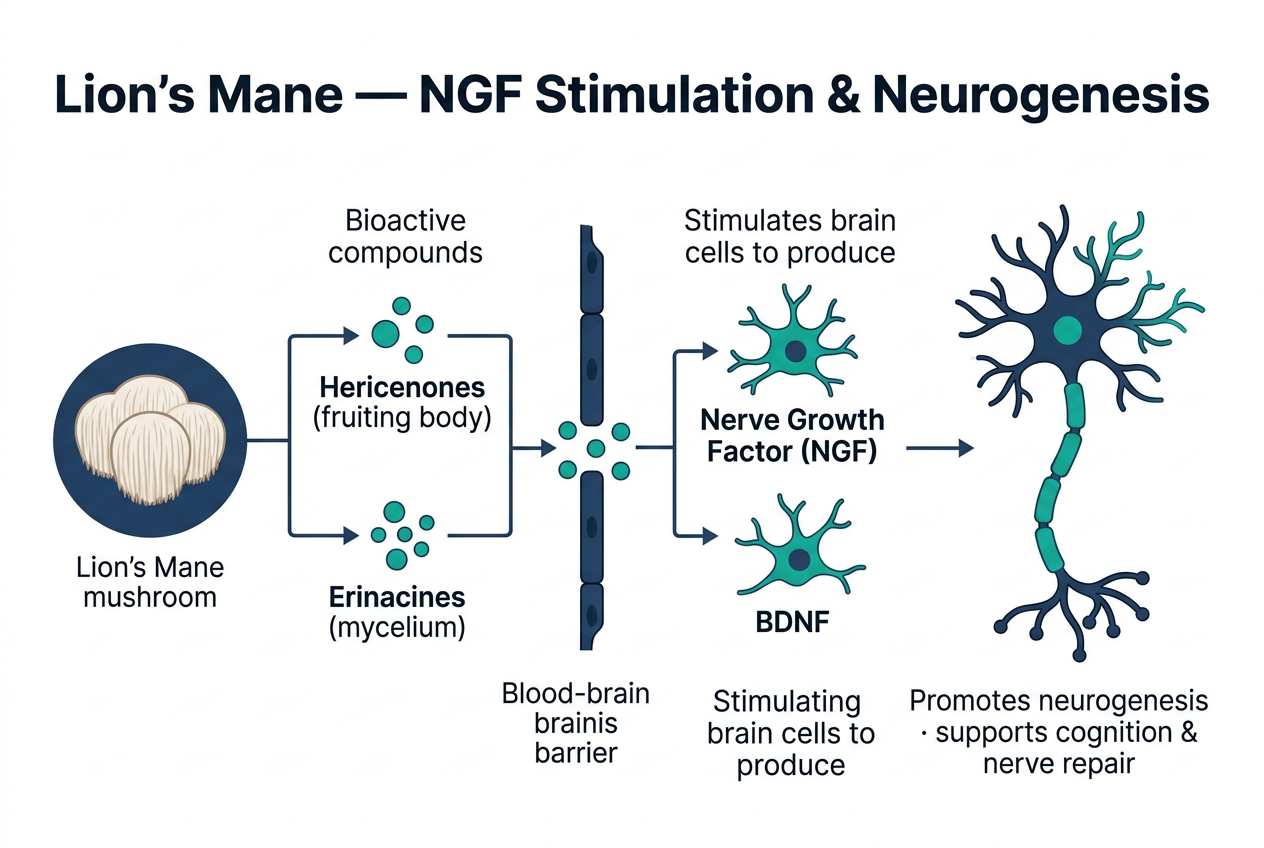
Hericenones and erinacines stimulate brain cells to produce NGF and BDNF, promoting neurogenesis and supporting cognition and nerve repair.
Beige/cream mushroom fruiting-body extract. Mild earthy-nutty flavor.
- Capsule
- Powder
- Liquid
- Gummy
Capsule is generally preferred for bioavailability or efficacy.
Mechanism of Action
Hericenones (fruiting body) and erinacines (mycelium) stimulate NGF and BDNF synthesis in the hippocampus. Promotes myelination, neurite outgrowth, and synaptic plasticity. Also exerts anti-inflammatory and antioxidant effects in neural tissue.
Physiological Role
Supports nervous system maintenance via neurotrophin upregulation. Contributes to memory consolidation, peripheral nerve repair, and neuroprotective defense against age-related cognitive decline.
Primary Pathways
Performance / Health Relevance
Primarily cognitive: supports sustained focus, memory under stress, and long-term brain health. Emerging evidence for mood regulation and anxiety reduction relevant to training consistency.
Evidence Review
Practical Use & Dosage
- Minimum Effective Dose
- 500mg/day (fruiting body extract)
- Optimal Range
- 1000–3000mg/day
- Upper / Caution Level
- 5000mg/day
- Timing
- Morning or split AM/PM
- Best Format
- Dual extract (fruiting body + mycelium) or hot-water extract
- Bioavailability
- Dual extraction (hot water + alcohol) yields both hericenones and erinacines
- Absorption Considerations
- Take with food for GI comfort; effects are cumulative over 4–8 weeks
Safety & Interactions
Side Effects
- •Mild GI discomfort (rare)
- •Skin irritation in sensitive individuals (very rare)
Contraindications
- Known mushroom allergy
Drug Interactions
- •Anticoagulants (theoretical platelet inhibition)
- •Immunosuppressants (immune-modulating effects)
Who Should Avoid
- •Those with mushroom allergies
- •Individuals on blood-thinning medication without medical guidance
Monitoring
Generally very safe; monitor for allergic reactions on first use
Frequently Asked Questions
Auto-generated from indexed evidence — dosage, safety, interactions, and more.
When is Lion's Mane typically used or indicated?
Lion's Mane is most commonly used for: Nerve growth factor support, Memory enhancement, Neuroprotection, Mood support. Supports nervous system maintenance via neurotrophin upregulation. Contributes to memory consolidation, peripheral nerve repair, and neuroprotective defense against age-related cognitive decline.
How does Lion's Mane work?
Hericenones (fruiting body) and erinacines (mycelium) stimulate NGF and BDNF synthesis in the hippocampus. Promotes myelination, neurite outgrowth, and synaptic plasticity. Also exerts anti-inflammatory and antioxidant effects in neural tissue.
What is the recommended dose of Lion's Mane?
The optimal range is 1000–3000mg/day. with a minimum effective dose of 500mg/day (fruiting body extract). Best taken: Morning or split AM/PM. Upper / caution level: 5000mg/day.
What are the side effects of Lion's Mane?
Reported side effects include: Mild GI discomfort (rare); and Skin irritation in sensitive individuals (very rare). Monitoring: Generally very safe; monitor for allergic reactions on first use
Does Lion's Mane interact with medications?
Known or theoretical interactions: Anticoagulants (theoretical platelet inhibition); and Immunosuppressants (immune-modulating effects). Always check with a clinician before combining with prescription medication.
Who should avoid Lion's Mane?
Lion's Mane is generally not recommended for: Those with mushroom allergies; Individuals on blood-thinning medication without medical guidance; and Known mushroom allergy.
How strong is the evidence for Lion's Mane?
Evidence level: Moderate (overall score 72/100), based on 2 indexed studies on SuppIndex.
Research & References (2)
Improving effects of the mushroom Yamabushitake on mild cognitive impairment
Japanese RCT showing 3g/day Lion's Mane for 16 weeks significantly improved cognitive function scores in older adults with mild cognitive impairment vs placebo.
Hericium erinaceus: an edible mushroom with medicinal values
Comprehensive review of Lion's Mane bioactives confirming NGF-stimulating, anti-inflammatory, antioxidant, and immunomodulatory properties.
Related Ingredients
Other top-rated ingredients in Nootropics.
Caffeine Anhydrous
90/100Methylxanthine alkaloid; non-selective adenosine A1/A2A receptor antagonist; raises cAMP, catecholamine release, and Ca²⁺ sensitivity in muscle.
Alpha-GPC
78/100Highly bioavailable choline donor that elevates brain acetylcholine levels, supporting memory, learning, and muscular power output via enhanced neuromuscular junction signaling.
L-Theanine
72/100A non-proteinogenic amino acid analog of glutamate that crosses the BBB, promoting alpha-wave brain activity and modulating inhibitory neurotransmitter balance.
Research Overview
Moderate EvidenceCite this ingredient
One-click citation export in APA, MLA, Chicago, BibTeX, or HTML. The URL below is stable and safe to link.
Stable URL
https://thesuppindex.com/ingredients/lions-mane
SuppIndex. (2026). Lion's Mane: Evidence summary, dosage and clinical studies. Retrieved October 23, 2026, from https://thesuppindex.com/ingredients/lions-mane
Based on 2 indexed studies · Evidence level: Moderate.
Goal Ratings
Stack Compatibility
Excellent synergy with Alpha-GPC for cholinergic + neurotrophic stacking. Pairs well with adaptogens.
Products (1)
Real Mushrooms
Lion's Mane Extract